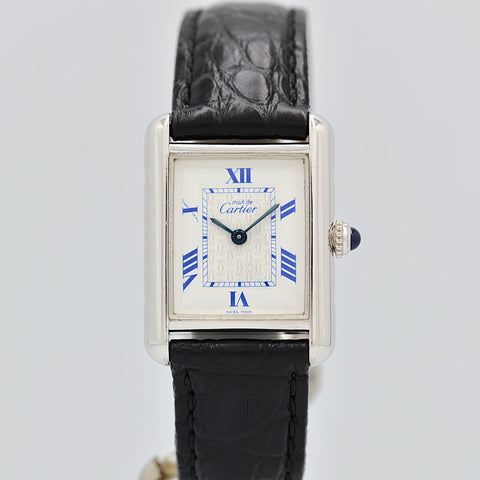

The "Cartier Must Tank" that arrived today is a late-model version that underwent a major minor change around 1999.
Compared to the old model, the case became larger and became waterproof, significantly improving its practicality.

With this minor change, the dial design also underwent significant alterations.
While the classic ivory Roman numeral design was also updated, the "jump hour" Roman numeral dial, which was added from the old model, not only changed the arrangement of the numerals but also introduced a lineup of two case colors: gold and silver.
The jump-hour Roman numeral dial that arrived this time features a silver case and gained popularity with a new look never before seen in the Must Tank line.
The combination of a silver or stainless steel case with blue indexes, as seen in Cartier watches of that era, is a distinctive design not found today, and it pairs exquisitely with the refreshing white dial and the spinel on the crown.

Many of the Must series had gold-colored cases, which gave them a somewhat flashy impression.
However, with the introduction of many silver-colored cases, which are standard for watches, more people began to wear the Must Tank.
Furthermore, this minor change not only altered the design but also significantly changed the materials and rigidity of each part.
The base of the crown was made of 18k gold, and the plastic inner case was eliminated, integrating with the case material and the case back.
Not only did it improve practicality over the conventional Must Tank, but it also gained further functionality by becoming more robust.

The Must Tank, which had a charming classical expression, gained a more modern impression due to the raised structure of the dial's index section, creating a step with the central part of the dial, making it appear more three-dimensional than conventional dials.
Additionally, the D-buckle became standard on later models, marking the birth of a new Must Tank that went beyond the scope of a minor change.
However, around 2004, all Must series models were discontinued, bringing an end to a long-selling product that had spanned 28 years since its introduction in 1976.
This is likely due to the high cost of the vermeil process used in the Must series and rising raw material prices, but it marked the end of an entry-level model that followed the Tank Louis Cartier design.
It would later evolve into the Tank Solo and Ronde Solo.
Recently, with the soaring prices of current models and a return to classic styles, interest in vintage and discontinued models has been growing, leading to an increasing popularity and price surge for the Must Tank.
Unlike current products that can be purchased anytime if you have the money, the rarity of a vintage watch, the thought that you might not be able to buy it again if you miss it now, should make you feel the value of vintage watches more strongly.
Naturally, if you can't maintain a watch after purchasing it, you'll feel that the time and money you spent were wasted.
All watches we sell are serviced.
And it's something you never know when you might be able to buy again.
If you understand the value of such a wonderful watch,
the opportunity to encounter this watch will surely be a wonderful one!