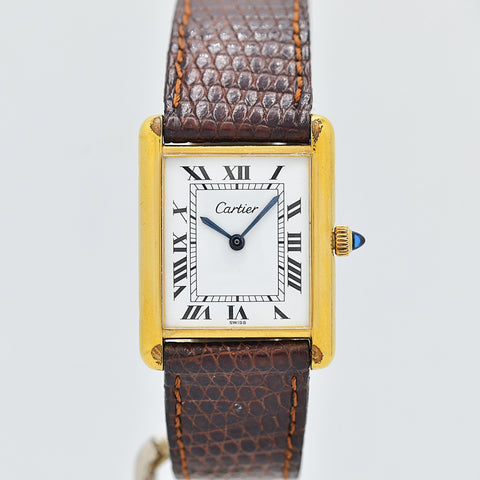

The "Cartier Pre-Must Tank" that arrived today is a very valuable item that still holds many mysteries.
If you're a vintage enthusiast, you can't miss a watch as intriguing as this.

The Pre-Must Tank was produced for a period before the "must de" inscription was printed on the dial.
The handwritten brand logo enhances its vintage charm,
and the adoption of the Tank Louis Cartier design adds to its appeal.
One theory suggests it was introduced around 1972 when Cartier began selling wristwatches to the general public,
but at that time, it was likely the North American version with a snap-back case.

This is the European-spec case, said to have circulated primarily in Europe.
The structure where the case is joined by screws from the case side
is a detail also seen in later Must Tanks.
Based on documentation, I deduce that
all models in Cartier's initial general sales lineup were solid gold.
Since Cartier products were very expensive at the time,
the Pre-Must Tank was born from an effort to create more affordable products.
However, it was produced independently by Cartier's American headquarters, which had different capital,
and later, as counterfeits began to circulate,
although European-spec Pre-Must Tanks were temporarily produced as a measure, they were irregular products.
It was in 1976 that Cartier officially established a production system as "must de Cartier."
Since it was lined up as the Must Tank from 1977,
the Pre-Must Tank ceased production.
The above is my own interpretation and speculation, but
for a piece previously sold at our store with a warranty, we confirmed it was sold in 1975,
meaning the North American version was produced for about 5 years.
Since the European version is believed to have an even shorter production period,
in terms of circulation, the European-spec Pre-Must Tank is definitely rarer than the North American version.
With an actual production period of around three years, opportunities to encounter one are limited.

The dial's design is so similar to the Tank Louis Cartier that it could be mistaken for it.
The secret signature at 7 o'clock is absent, indicating its age, and
the European specification features steel blue hands.
However, the manufacturer considers them non-original since they aren't black hands.
Based on all European-spec Pre-Must Tanks I've seen in the past, both LM and SM sizes, only steel blue hands were present,
so the consistency of the hands should be correct here.
The dial finish has more of a semi-gloss texture rather than the lacquer finish of the Must Tank.
While some show cracks due to age,
many also suffer from discoloration and other damage,
so the damage to the dial varies from piece to piece.
However, this particular piece is very clean with no noticeable damage or cracks.
This alone should make you appreciate its value.
Also, the crown's pointed spinel
could potentially chip if bumped,
leading me to believe it was changed to a rounded spinel in the Must Tank.

The European-spec Pre-Must Tank has an engraving on the case back.
The goal was to reduce costs compared to solid gold by using a 20-micron gold-plated case,
but later, many watch brands completely abandoned gold-plated cases due to the higher labor costs for craftsmen.
While the Must Tank features gold plating on a sterling silver surface,
the Pre-Must Tank has gold plating on a brass surface,
making the difference not just in watch details but also in materials uniquely interesting.

The movement is the ETA Cal. 2512, also used by many watch brands including Cartier.
It's highly regarded for its stable accuracy and durability, among other qualities, and
it differs slightly from the hand-wound Must Tank models, indicating
that this piece, including its movement, pursued a high degree of originality.

The buckle is a "double C" classic buckle, featuring the Cartier logo of that era.
The intertwined "C" design of Cartier has a certain charm, but
since these parts are also limited in number,
you can imagine how precious they are.

Even in this age where all sorts of information are available,
accurate information about vintage models like this is still not publicly disclosed,
and it's unclear what is correct.
However, unraveling such mysteries is also part of the appeal of vintage items,
making them wonderful pieces that ignite a spirit of inquiry.
I've written as much as I currently know in this blog,
but there might be new truths to uncover.
I don't know when that will be,
but one thing is certain: this watch is not easy to acquire.
That is an undeniable fact.
This time, we received a piece with a good dial condition,
but it might be years before another one comes along.
So, there's no reason to miss out on this watch, is there?