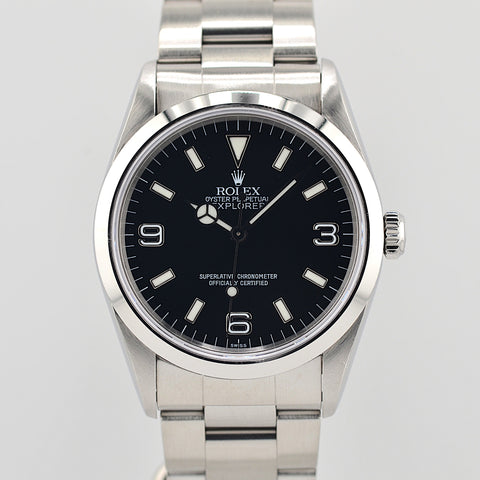

The Rolex Explorer I, which arrived today,
is a professional watch for explorers that debuted in 1953.
It is a masterpiece that thoroughly pursued the essence of a wristwatch, stripping away all unnecessary embellishments.

This is the Re.14270, which underwent a major minor change and was released in 1990.
It's not an exaggeration to say it was the spark that ignited the luxury wristwatch boom in Japan,
and isn't it the representative Rolex model that many people have seen?
In the late 1990s, it became a hot topic when a top idol, who was also a fashion icon in Japan, wore it,
and at one point, it commanded a premium price exceeding even the Rolex Daytona,
becoming explosively popular as the Explorer I.
From there, a close relationship between fashion and wristwatches was established, which continues to this day.
The anecdotes about this watch are simply inexhaustible.

I myself once longed for and acquired an Explorer I.
It was a masterpiece that captivated not only watch enthusiasts but also a wide range of fashion lovers,
not just because of the influence of famous idols, but also because many celebrities wore it at the time.
Many people today have the desire to "buy a good wristwatch when they become adults,"
but before the Explorer I became popular, with the exception of watch lovers,
the idea of owning a luxury watch, such as for an engagement gift or as a pair watch,
was somewhat different from today, as I recall.
And most importantly, the price of luxury watches from the late 1990s to the late 2000s
was much more affordable than it is now.
Although it was nearly 30 years ago,
the Explorer I can be called a witness to the changing times.

From the 1990s to the early 2000s, various minor changes were made at Rolex,
and the Re.14270 shows differences in details throughout since its introduction.
This particular model was manufactured around 1998, when the switch was made from tritium luminous material to Luminova luminous material,
and has the designation "SWISS" at the 6 o'clock position, commonly known as "only Swiss."
When tritium luminous material was used, the notation was "T SWISS T" or "SWISS-<25",
and when it completely switched to Luminova luminous material, it was marked "SWISS MADE",
but some watches manufactured from late 1997 to early 1999 are marked "SWISS".
In recent years, such subtle differences can lead to price discrepancies compared to other models,
making it a truly Rolex-like item where differences in detail can determine the fate of the watch.

Regardless of its manufacturing year, the Explorer I is the smallest sports model,
making it one of the most wearable watches for Japanese people.
This size may have contributed to its soaring popularity,
but the watch's design is also supremely simple, with a stoic feel,
so it may have been a good match for the fashion scene at the time.
This trend has continued to the present day; although the current Explorer I temporarily became larger,
it is now offered in the same size as this one, which confirms
that this size is the optimal size for this watch.
For a wristwatch, size is just as important as design when wearing it.
And because it has details unlike any other, the appeal of wristwatches is endless.
This particular model, in addition to its perfected design, is a sports model that can be used with confidence every day.
It has no unnecessary functions, making it very easy to handle,
and even those who are new to mechanical watches can use it with peace of mind.
Rolex watches are not only robust,
but with regular maintenance, they can be used for generations.
If this isn't excellent, what is?